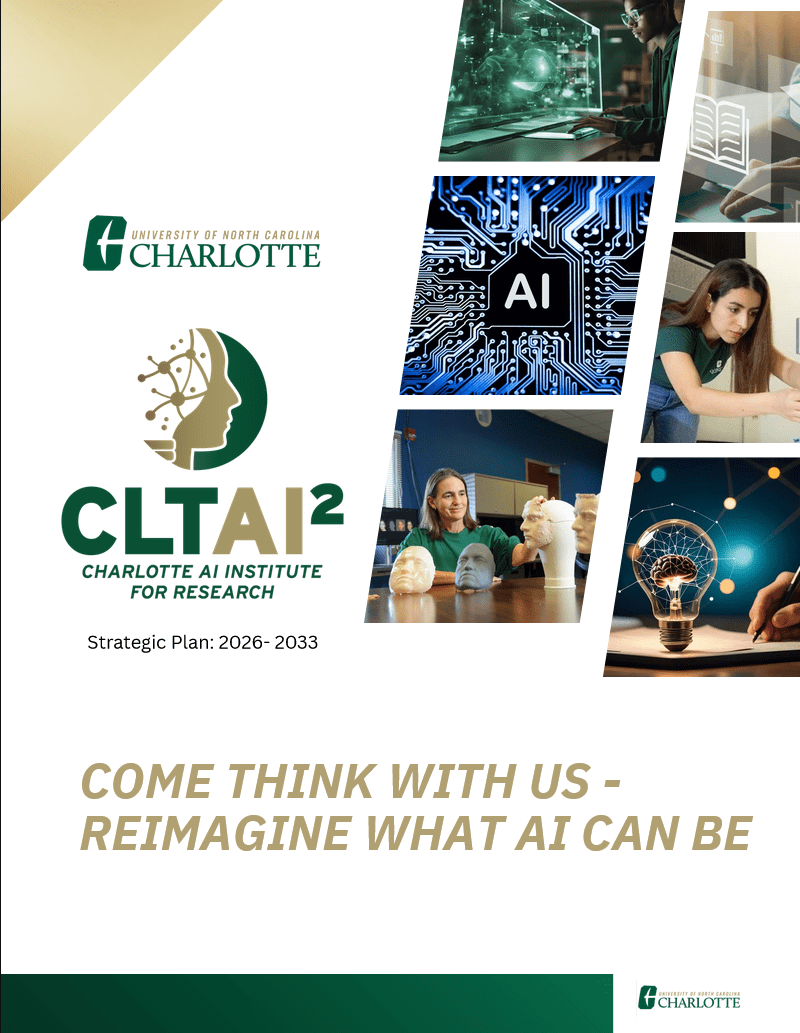
Charlotte AI Institute Strategic Plan: 2026-2033
CHARLOTTE AI INSTITUTE (CLTAI2)
Catalyzing Artificial Intelligence Research & Innovation Today for a Better Tomorrow

Launching a New Era of Innovation: The Charlotte AI Institute for Research Strategic Plan 2026-2033
Our Mission: The Charlotte AI Institute is a catalytic hub and dynamic collaborative for interdisciplinary and transformative AI research — mobilizing scientific discovery, cultivating strategic partnerships and positioning UNC Charlotte as a global leader with impact across North Carolina and beyond.
Our Vision: The Charlotte AI Institute and UNC Charlotte will ambitiously forge bold, life-changing AI solutions to improve people’s lives across the Charlotte Region and around the globe.
COMe think with us –
reimagine what ai can be
Introduction & Values
View Introduction
Artificial intelligence is reshaping every sector — from health care and education to transportation, finance, commerce and the creative industries. This rapid evolution brings extraordinary opportunities and complex challenges, demanding thoughtful leadership, rigorous research and cross-sector collaboration.
UNC Charlotte embraces this moment with clarity and purpose. North Carolina’s growing AI start-up scene demands sustained University-driven research and development to thrive. As the Charlotte region’s only R1 public research university and a recognized leader in AI, UNC Charlotte mobilizes talent, research and strategic partnerships to accelerate the University’s rise as a national and international AI hub — advancing innovation responsibly and delivering broad societal impact. The Charlotte AI Institute, known as CLTAI2, anchors this commitment.
The Charlotte AI Institute Strategic Plan, 2026-2033 outlines three imperatives:
• Forge dynamic, collaborative AI research and innovation
• Catalyze a networked hub of internal and external collaborators
• Build an operational framework for sustained growth
This plan reflects the shared belief of the strategic planning committee that UNC Charlotte has both the responsibility and opportunity to shape the future of AI – advancing discovery, strengthening communities and contributing to global progress.
UNC Charlotte’s strengths in interdisciplinary research, regional engagement and innovation position the University to meet the challenges ahead through cutting-edge AI innovation aligned with the public good.
We invite faculty, staff, students, partners, affiliates and community members to join us. Together, we will ensure Charlotte and UNC Charlotte are central actors in the global story of AI — leaders who bring excellence and responsibility to the forefront of AI innovation.
View Values
Responsible and Impactful: We advance AI research and education with integrity, scientific rigor and ethical responsibility, ensuring flexible, transparent and transformative outcomes that address societal challenges and empower communities.
Collaborative and Catalytic: We serve as a high-powered center of AI leadership, actively promoting collaboration across disciplines, colleges and sectors to address complex societal challenges.
Innovative and Practical: We prioritize cutting-edge research that bridges theory and practice to apply AI to real-world challenges.
Local and Global: Our work is inspired by regional needs, delivering AI solutions that have an impact on a global scale.
Forge Dynamic, Collaborative AI Research and Innovation
Let’s research — together, ambitiously and with real-world impact.
Goal A1. Drive impact through aligned priorities, responsiveness to community needs and public-facing innovation.
- Objective A1.1. Align the Institute’s core research and innovation strengths with the priorities of Charlotte’s industry, government and community partners.
- Action A1.1.1. Integrate industry, community and funding agency priorities into iterative, responsive research that delivers solutions to regional, national and global challenges.
- Action A1.1.2. Advance the Institute’s core focus areas: AI foundation building, research on AI in education and workforce, AI evaluation and assurance, developing clear ethical AI standards and frameworks, and AI translation to practice.
- Action A1.1.3. Leverage other existing UNC Charlotte research strengths — advanced manufacturing and metrology, energy and infrastructure, life and health sciences, cybersecurity, artificial intelligence and data science — as a pathway to prominence.
- Objective A1.2. Accelerate research into real-world impact through commercialization, policy engagement and public benefit.
- Action A1.2.1. Fast-track technology transfer and commercialization by activating intellectual property guidance, working with industry partners on use-inspired research and nurturing startups.
- Action A1.2.2. Promote open science practices that link disruptive innovation, commercialization and public benefit.
- Action A1.2.3. Translate research into flagship publications and public-facing outputs — such as policy briefs, media features and community engagement.
Goal A2. Deliver real-world solutions through collaborative, large-scale, highly scalable, multi-partner research and innovation.
- Objective A2.1. Build infrastructure to power bold projects that drive change.
- Action A2.1.1. Expedite large-scale, multi-partner research toward competitive external funding through targeted support, high-powered tools, launchpads and proposal accelerators.
- Action A2.1.2. Enhance the capacity, sustainability and cross-collaboration of AI centers across campus to collaboratively guide and align the University’s AI strategy.
- Action A2.1.3. Facilitate researcher access to systems, tools and technical support for collaborative, scalable AI research by harnessing the collective expertise across internal University groups.
- Objective A2.2. Form targeted, quick-moving, interdisciplinary researcher-partner teams to shape discourse, advance scholarship and win competitive funding.
- Action A2.2.1. Enable research teams with tools, training, grant-writing support and mentoring to secure funding, share knowledge and drive real-world impact.
- Action A2.2.2. Activate a targeted seed grant initiative to convert early-stage collaborations into fundable pilot projects and validated proof-of-concept models.
Catalyze a Networked Hub of Internal and External Partnerships
Let’s get together (network), think together (hub) and move forward together.
Goal B1. Mobilize enduring partnerships across sectors and scales, working with industry, government, and non-profit and grassroots community organizations from local collaborators to global powerhouses.
- Objective B1.1. Accelerate high-impact partnerships to boost the Institute’s visibility, credibility and strategic position.
- Action B1.1.1. Secure early wins and headline partnerships to demonstrate the Institute’s credibility, catalyze institutional buy-in and position the Institute and its strategic plan for rapid traction.
- Action B1.1.2. Pursue direct engagement with major tech companies to secure relevance, visibility and strategic alignment in the global AI ecosystem.
- Action B1.1.3. Launch, create by-laws and convene the Charlotte AI Institute External Advisory Board of cross-sector leaders who guide initiatives, identify collaboration opportunities and shape mutual priorities.
- Action B1.1.4. Convene and partner with the AI Research Council, as an internal committee of campus leaders for guiding a university-wide agenda and shaping robust standards and practices for Ethical AI in the University ecosystem.
- Objective B1.2. Build sustainable partnership infrastructure that encourages long-term engagement and responsive innovation.
- Action B1.2.1. Implement a scalable partnership model that establishes shared values, clarifies expectations and promotes long-term engagement.
- Action B1.2.2. Refine research agendas and innovation pathways continuously based on insights from external partners and advisory board feedback.
Goal B2. Activate a catalytic hub that advances AI scholarship and amplifies its dissemination.
- Objective B2.1. Build a fast-paced collaborative ecosystem for AI research, innovation and strategic engagement.
- Action B2.1.1. Convene interdisciplinary and intersector teams of internal and external stakeholders to co-design research opportunities and collaborations.
- Action B2.1.2. Host regional symposia and engagement events around shared AI themes.
- Action B2.1.3. Translate convening insights into actionable frameworks that address emerging AI trends and tensions.
- Action B2.1.4. Facilitate development of and access to training pathways to serve as sustainable and adaptable resources for community partners within and outside of the University.
- Objective B2.2. Strengthen UNC Charlotte’s internal AI network and welcome emerging scholars.
- Action B2.2.1. Establish Institute Associates to guide and advance initiatives.
- Action B2.2.2. Engage faculty, students and postdoctoral fellows through the Affiliate network.
- Action B2.2.3. Collaborate with AI-engaged colleges, departments and mission-aligned offices as strategic allies in the Institute’s work.
- Acton B2.2.4. Involve students and postdoctoral researchers through research, innovation, convenings and internships.
Build an Operational Framework for Sustained Growth
Let’s organize for success.
Goal C1. Amplify the Institute’s identity and visibility through a bold and integrated communications platform.
- Objective C1.1. Establish a compelling communications strategy for identity and recognition.
- Action C1.1.1. Define and activate the Institute’s brand identity and its value proposition.
- Action C1.1.2. Highlight the accomplishments of centers, affiliates, associates and partners to enhance collective visibility.
- Action C1.1.3. Craft and circulate compelling, evidence-backed narratives that link the AI Institute’s bold vision to concrete University examples — such as early AI hiring, strategic partnerships, ethical and policy impact, and high-profile collaborators — to build internal belief in capacity and external credibility.
- Objective C1.2. Develop a communications platform that fosters engagement and broad reach.
- Action C1.2.1. Launch a dynamic website and digital media channels to amplify the successes and impact of UNC Charlotte AI research and innovation.
- Action C1.2.2. Generate materials for distribution that articulate and amplify Institute activities, offering a consistent message and design that integrates and supports the centers.
Goal C2. Build long-term Institute resilience through operational durability and strategic investment.
- Objective C2.1. Design a durable foundation for Institute operations, oversight, and governance.
- Action C2.1.1. Define roles, responsibilities, and operational structures, such as governance and oversight, to ensure the Institute’s long-term effectiveness.
- Action C2.1.2. Engage the AI Research Council and Working Groups to develop clear processes for decision-making, evaluation, and continuous improvement to ensure responsive, transparent Institute operations.
- Objective C2.2. Strengthen financial sustainability and strategic investment.
- Action C2.2.1. Create varied revenue streams that align with the Institute’s mission and impact goals.
- Action C2.2.2. Launch a tiered corporate sponsorship model and major donor strategy to build long-term financial strength.
- Action C2.2.3. Leverage internal and external partnerships to develop shared energy-efficient infrastructure and instrumentation, prioritizing environmental sustainability and renewables.
Message From George Banks & Stephanie Schuckers
View Message
The Charlotte AI Institute for Research (CLTAI2) is pleased to share its Strategic Plan 2026-2033, outlining a clear path for advancing AI research and innovation at UNC Charlotte. The Institute is already accelerating this vision through ThinkAI Meetups, ethical policy development, and high-impact NSF-funded center awards. By bridging interdisciplinary discovery and collaboration across campus with real-world applications through strategic external partnerships, CLTAI2 ensures the University remains at the center of the national AI landscape.
Thank you for being part of this exciting momentum.
Sincerely,
George and Stephanie
co-directors, Charlotte AI Institute for Research (CLTAI²)
Process
32 AI institutes at R1 universities refine the direction of CLTAI2
In fall 2024, UNC Charlotte Chancellor Sharon Gaber established a University-wide institute to advance artificial intelligence (AI) research and collaboration across disciplines and sectors. Vice Chancellor for the Division of Research John Daniels appointed Drs. George Banks and Stephanie Schuckers to co-lead the newly established Charlotte AI Institute, supported by a Strategic Planning Committee comprising AI-engaged faculty and AI center directors.
To shape the Institute’s direction, Daniels, Schuckers, Banks and Associate Vice Chancellor for the Division of Research Deborah Thomas, convened a retreat on May 15, 2025, bringing together SPC members, the UNC Charlotte AI Research Council and other University experts. The retreat clarified scope, roles and stakeholder impact and surfaced key functions and themes that formed the foundation for the Institute’s strategic plan. Participants agreed that the AI Institute would not focus on AI education, given existing academic structures and efforts.
Following the retreat, the SPC benchmarked 32 AI institutes at R1 universities to refine the direction of CLTAI2. Drawing on insights from the retreat and benchmarking, the SPC developed a plan that underwent 18 drafts before requesting community feedback. Input mechanisms included a survey (Sept. 24-Oct. 21, n = 10) and focus groups (week of Oct. 6, five groups, 16 participants) with UNC Charlotte AI researchers and center directors. Survey responses surfaced key concepts and phrases, which were then used as prompts in the focus groups to deepen understanding.
Based on this input, the SPC refined CTLAI2‘s mission, vision, values and plan structure through ten additional drafts. Dr. John Daniels, Dr. Deborah Thomas, Provost Jennifer Troyer and Chancellor Gaber provided further feedback. The SPC approved the final strategic plan on Mar. 20, 2026.
Strategic Planning Committee
View Strategic Planning Committee
- George Banks, professor of management; co-director, Center for Leadership Science; co-director, CLTAI2
- Sabri Gökmen, assistant professor of architecture
- Daniel Janies, The Carol Grotnes Belk Distinguished Professor of Bioinformatics and Genomics; co-director, Computational Intelligence to Predict Health and Environmental Risks
- Taufiquar Khan, chair and professor of mathematics; director, Center for TAIMing AI
- Jose Outeiro, professor of mechanical engineering and engineering sciences
- Stephanie Schuckers, Bank of America Distinguished Professor in Computing and Informatics; director, Center for Identification Technology Research; co-director, CLTAI2
- Pu Wang, associate professor of computer science; co-director, AI4Health
- Damien P. Williams, assistant professor of philosophy, School of Data Science
- Facilitator: Sharon A. McDade, Ed.D., practice leader for strategic services, Greenwood Asher & Associates
For more information
Discover the Charlotte AI Institute for Research’s vision for the future by accessing our comprehensive strategic plan. Click here to explore how they will ambitiously forge bold, life-changing AI solutions to improve people’s lives across the Charlotte Region and around the globe!